Fish pond liners: what's genuinely fish-safe
Which liner materials are truly safe for koi and goldfish, which ones to avoid, and how deep and smooth a fish pond really needs to be.
A fish pond liner has one job on top of holding water: it has to stay chemically inert for the whole life of the pond. Fish pond liners that leach softeners or biocides can burn gills, cloud water and slowly kill stock, so the material you choose matters more than for a plain wildlife pool. That goes double for a koi pond liner, where deep water and high stocking density leave no margin for cheap materials.
The good news: a handful of well-known materials are genuinely fish-safe and available off the shelf in the UK. The trick is knowing which grade you're buying.
What "fish-safe" actually means
"Fish-safe" is not a legal term — it's shorthand for a liner that won't leach anything harmful into the water once it's submerged. In practice that means three things: no plasticiser migration (the softeners used to make cheap PVC flexible), no biocide or fungicide additives (common in roofing membranes), and material approved to potable-water-style standards such as WRAS in the UK.
Reinforced polymer membrane, fish-grade EPDM and traditional butyl all meet that bar. The word to look for on a product spec sheet is "fish-safe" or "potable-grade" — if it isn't stated, assume it isn't.
Material rundown for fish ponds
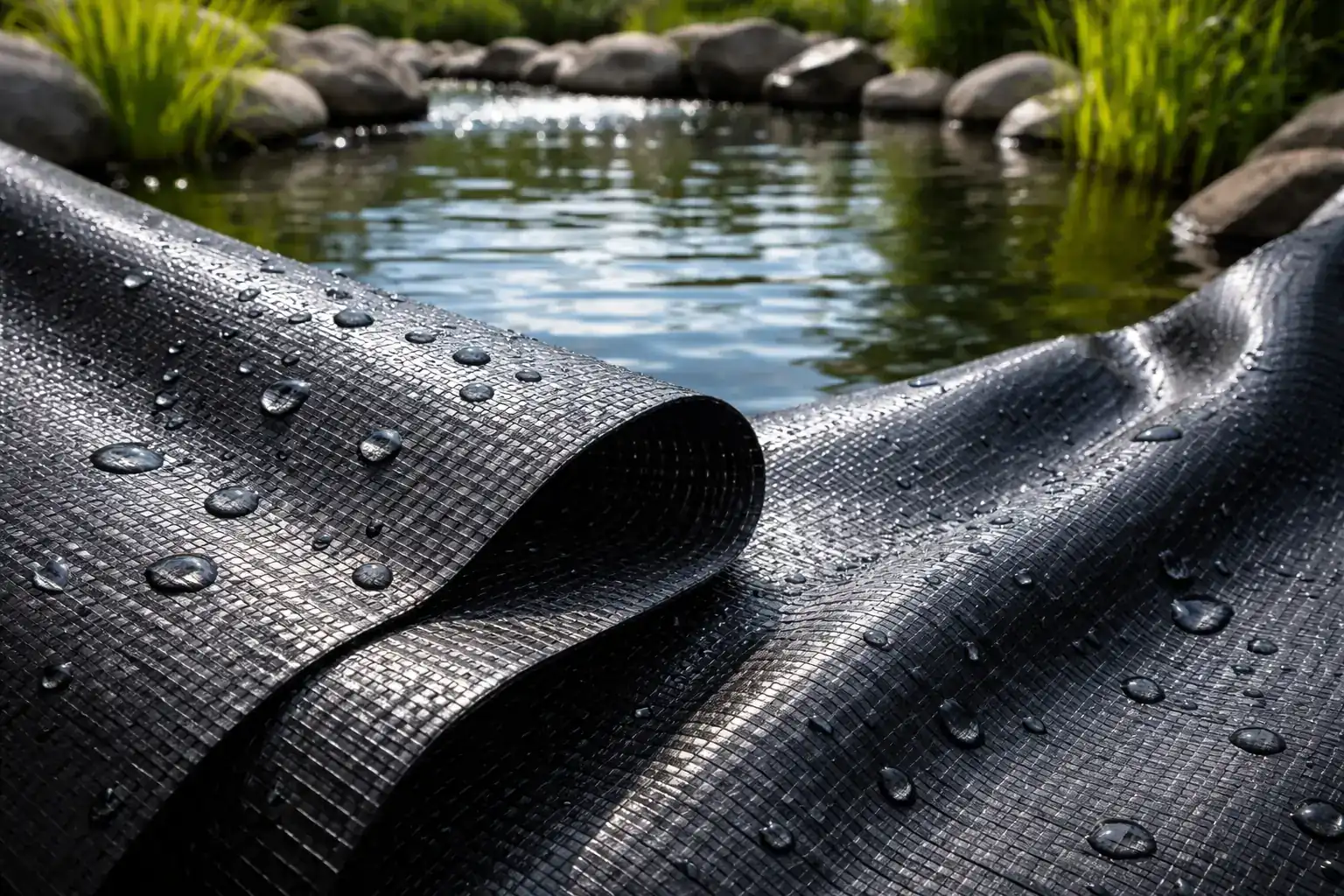
- RPM (reinforced polymer membrane). 0.7 mm, fish-safe, weldable on site. Light enough to drape into a formal koi pond without folds. Our recommended default for both goldfish and koi builds — see the RPM 0.7 mm page for the full spec.
- EPDM (fish-safe grades only). Synthetic rubber, typically 1.0–1.5 mm. Excellent for garden fish ponds when you buy a grade explicitly sold as pond/fish liner. Roofing-grade EPDM looks identical but contains additives that are not fish-safe — never substitute it.
- Butyl rubber. The traditional UK fish pond material. Fish-safe, long-lived, and still a solid choice — just heavier and more expensive per m² than modern RPM.
- Cheap PVC — avoid for koi. Standard PVC pond liners rely on plasticisers to stay flexible. Over years those plasticisers migrate out, the liner turns brittle, and trace amounts end up in the water. Fine for a short-life ornamental pool; not something to put valuable koi into.
Koi pond liners: depth, smoothness and welded seams
A koi pond liner has to cope with more than a garden pond. Koi need at least 1.2 m of depth (1.5 m is better) so they have thermal stability in winter and room to grow. That depth also means straight, near-vertical walls, which flexible sheets can only handle cleanly if they're box-welded to shape.
Surface finish matters too: koi swim close to the liner and can damage fins on rough seams or exposed folds. That's the main argument for a box-welded made-to-measure liner on any formal koi build — the seams sit at the corners, out of the way, and the base is a single smooth panel.
Work out your fish pond liner size
Enter your pond's length, width and maximum depth in the pond liner calculator — it applies the standard overlap formula and shows the exact fish-safe RPM sheet you need.
Fish pond liner FAQ
Ready for a reinforced pond liner that lasts?
RPM is the reinforced pond liner material trusted by installers across the country — 0.7 mm polymer membrane, koi-safe, 45-year lifespan.