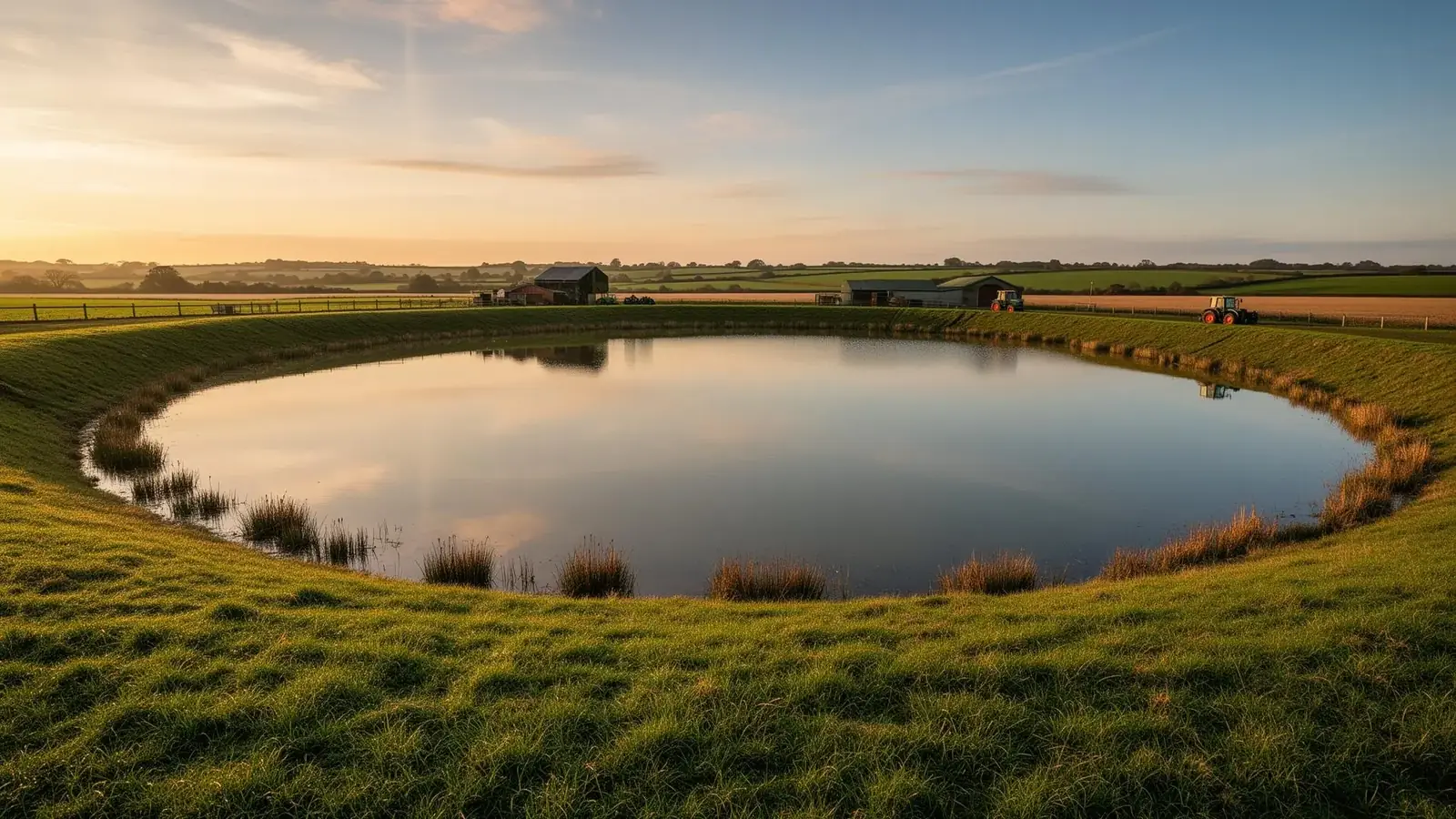
Agricultural pond and lagoon liners
An agricultural pond liner is a reinforced flexible membrane used to waterproof slurry lagoons, irrigation reservoirs, livestock drinkers, rainwater harvesting tanks and fish-farming ponds across UK farms. Our 0.7 mm reinforced polymer (RPM) liner is welded on site into seamless panels of any size and carries a 45-year lifespan against UV and material failure.
Agricultural liners: full specification
Overview
Agricultural lining is a different discipline from ornamental pond work. A farm pond liner has to cover large, often irregular areas — typically 500 to 10,000 m² — sit reliably over subsoil that has been excavated rather than landscaped, and stay watertight under pressure heads of two metres or more.
It also has to deal with content that is rarely just clean water: slurry, dirty-water run-off, silage effluent, fertigation solutions and abstracted river or borehole water all have their own chemistry.
A reinforced polymer membrane suits this brief because the internal polyester scrim carries the tensile load, allowing a thin, light sheet to span large areas without seam-tape weak points or the heavy plant needed for HDPE wedge welding.
Common use cases
On a working UK farm, the same reinforced membrane covers a wide spread of jobs:
- Irrigation reservoirs holding winter abstraction for summer use under WRA permits.
- Slurry and digestate lagoons storing the output of dairy units and AD plants between spreading windows.
- Dirty-water and silage-effluent stores keeping yard run-off out of watercourses.
- Livestock drinking-water reservoirs and high-level header tanks supplying troughs by gravity.
- Rainwater harvesting basins feeding wash-down and crop spraying.
- Fish-farming grow-on and broodstock ponds needing a fish-safe surface for trout, carp or coarse species.
- On-farm biodiversity ponds, wetland treatment cells and lined attenuation features required under SuDS conditions.
Why reinforced polymer
Reinforced polymer is well suited to agricultural use for four practical reasons:
- Panel welding. Pre-fabricated panels are joined on site with a hot-air iron into a continuous sheet, so even multi-thousand-square-metre lagoons go in without taped seams.
- Puncture resistance. The woven scrim spreads point loads from flinty subsoil, livestock hoof traffic at margins and the pull-back of winter ice better than unreinforced rubbers.
- Durability. UV-stabilised polyolefin skins are rated for cold flexibility down to roughly -30 °C and warm-side stability to +70 °C, comfortably inside the UK envelope, with a 45-year lifespan and field life routinely exceeding 30 years.
- Livestock and fish safety. The membrane is plasticiser-free and inert, with no leachates that affect water chemistry for stock or stocked fish.
Installation
Most agricultural installs follow the same rhythm. The basin is excavated and dressed to remove sharp stones and roots, with a fall to a designated low point for any future drain-down.
A geotextile underlay — typically 300 gsm on clean ground, stepping up to 500 gsm on flint, shale or reclaimed subsoil — is laid across the full area and 1 m beyond the planned waterline. Pre-fabricated RPM panels are then rolled out, overlapped and hot-air welded into a single membrane. Edges are anchored in a perimeter trench, backfilled with the original spoil.
No specialist plant is required beyond a small excavator and the welding kit. UK regulatory context — for example the Silage, Slurry and Agricultural Fuel Oil (SSAFO) Regulations for slurry and silage stores, and Environment Agency or SEPA permitting for abstraction reservoirs — sets impermeability, freeboard and inspection expectations that any competent designer will build into the specification; treat it as a design input rather than something the liner alone satisfies.
Sizing & cost
Size a farm liner as basin length + 2× maximum depth + 1 m overlap, by basin width + 2× maximum depth + 1 m overlap. For lagoons above roughly 500 m², add 8–12% to account for panel-weld overlaps. Underlay is ordered to the same finished dimensions.
Three factors usually drive the per-square-metre cost:
- Total area — rates fall sharply above 1,000 m² because pre-fabrication and freight are more efficient.
- Site access for delivery and panel handling.
- Underlay specification dictated by the subsoil.
Installer-fit pricing additionally reflects travel, trench excavation and any abstraction-control or inlet/outlet penetrations that need detailing. As a rough guide, fitted RPM agricultural lagoons typically sit 25–40% below the installed cost of welded HDPE of comparable lifespan, before counting the heavier plant HDPE requires.
Plan your install
Use the free pond liner size calculator to convert basin dimensions into a sheet size, then cross-check the membrane against the full reinforced polymer (RPM) spec sheet or read the wider pond liner materials hub for honest buyer's guides on EPDM, butyl, PVC, HDPE, RPE and fibreglass. Before you order, our guide on how to measure your pond for a liner walks through the drape-and-overlap formula at scale, and whether you need pond underlay covers the geotextile spec that protects the liner over the long term.
Agricultural liners FAQ
Related
Pond liner calculator
Size your liner and underlay in seconds.
Open calculatorRPM 0.7 mm liner
Full spec, pricing and 45-year lifespan.
See productGolf-course liners
A golf course pond liner is a reinforced flexible membrane used to waterproof water hazards, irrigation storage lakes, decorative course features and balancing ponds. Our 0.7 mm reinforced polymer (RPM) liner welds on site into seamless panels of any size and freeform shape, finishes in a matte black that reads as deep water from the tee, and carries a 45-year lifespan.
ExploreLake liners
A lake liner is a large-format reinforced membrane welded on site to make a watertight basin where puddled clay or bentonite is impractical or too slow to install. Our 0.7 mm reinforced polymer (RPM) lake liner is fish-safe, weldable into any size and shape, and carries a 45-year lifespan — used across fishing lakes, ornamental estate lakes, conservation wetlands and flood-attenuation features.
ExploreWater management liners
A water management liner is a reinforced flexible membrane used to waterproof the attenuation basins, balancing ponds, spill-containment lagoons and SuDS pollution-control features that sit alongside highways, industrial yards, commercial developments and infrastructure projects. Our 0.7 mm reinforced polymer (RPM) liner is hot-air welded on site into seamless panels of any size, resists hydrocarbons, sediment and chloride exposure from run-off, and carries a 45-year lifespan against UV and material failure.
ExploreReady for a reinforced pond liner that lasts?
RPM is the reinforced pond liner material trusted by installers across the country — 0.7 mm polymer membrane, koi-safe, 45-year lifespan.