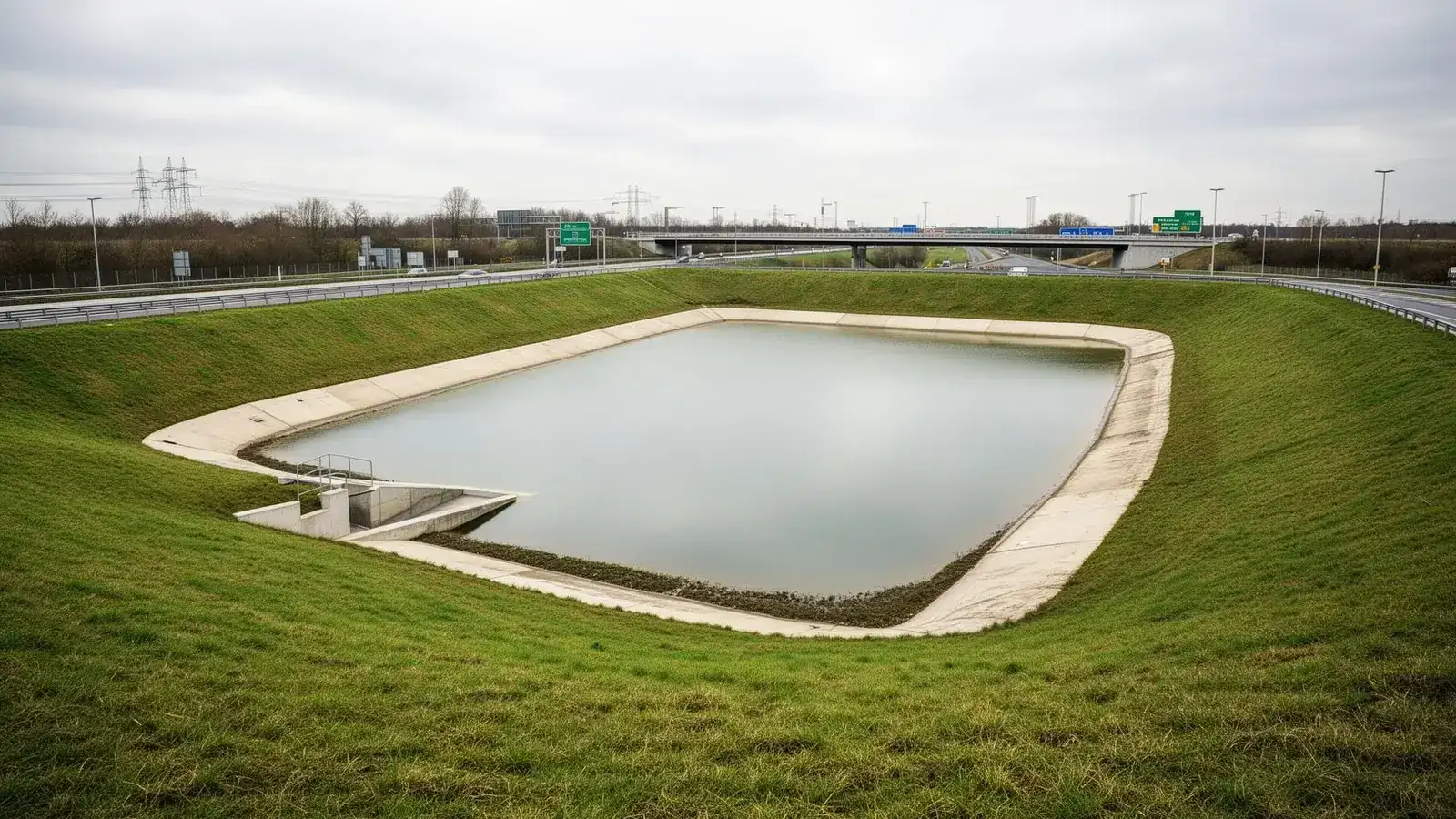
Water management liners
A water management liner is a reinforced flexible membrane used to waterproof the attenuation basins, balancing ponds, spill-containment lagoons and SuDS pollution-control features that sit alongside highways, industrial yards, commercial developments and infrastructure projects. Our 0.7 mm reinforced polymer (RPM) liner is hot-air welded on site into seamless panels of any size, resists hydrocarbons, sediment and chloride exposure from run-off, and carries a 45-year lifespan against UV and material failure.
Water management liners: full specification
Overview
Surface-water management is a different brief from agricultural or amenity lining. Run-off arrives in short, sharp pulses after rainfall on impermeable hardstanding, brings rubber, hydrocarbons, sediment and — through winter — chloride-rich de-icing salt with it, and has to be attenuated, treated and discharged at a controlled rate set by the lead local flood authority or SuDS approving body.
The lined basin is one element inside a wider treatment train that has to satisfy the CIRIA SuDS Manual (C753), local planning conditions and, on highway schemes, the Design Manual for Roads and Bridges (DMRB) — notably CG 501 and LA 113. Those documents drive basin geometry, freeboard, residence time and pollution-control performance; the membrane's job is to deliver the impermeable, chemically stable, long-life surface those designs assume underneath.
Reinforced polymer suits that brief because the welded panel construction has no seam-tape weak points, the polyolefin skins resist hydrocarbons and chloride exposure typical of site run-off, and the scrim spreads point loads from the angular fill commonly used in civils earthworks.
Common use cases
Across highway, industrial and development schemes the same reinforced membrane is specified for a wide range of water-management features:
- Attenuation basins holding storm flows from roofs, car parks and hardstanding before controlled release to a watercourse or surface-water sewer.
- Balancing ponds smoothing flows between sub-catchments on business parks, logistics sites and highway corridors.
- Spill-containment lagoons sized to capture a tanker- or process-spill volume, with penstocks for isolation downstream.
- Lined SuDS treatment features — wet ponds, forebays, sediment traps and bypass cells — providing the pollution-control stage of the C753 treatment train.
- Lined swale low points and infiltration-controlled basins on sites where the underlying ground is unsuitable for unlined infiltration.
- Construction-phase sediment lagoons and temporary spill catchment during major scheme delivery, demolition and resurfacing works.
Why reinforced polymer
Reinforced polymer is well suited to surface-water management for four practical reasons:
- Hydrocarbon and chloride resistance. The UV-stabilised polyolefin skins shrug off the diluted hydrocarbon, rubber-particulate and de-icing salt loadings typical of site run-off, without the plasticiser migration that affects flexible PVC over time.
- Welded panel construction. Pre-fabricated panels are hot-air welded on site into a continuous membrane with no taped seams, which matters for spill-containment lagoons where a single welded surface is far easier to demonstrate as impermeable than a taped or overlapped one.
- Puncture resistance. The internal polyester scrim spreads point loads from the angular Type 1 and 6F2 fills common in civils earthworks, and tolerates the maintenance traffic that periodically accesses inlet, outlet and penstock structures.
- Durability. A 45-year lifespan and real-world field life routinely exceeding 30 years matches the design life expected of a drainage asset, with field-repairable welded patches if a future intervention damages the membrane.
Installation
Water-management basin installs follow the same rhythm as other large RPM lining jobs, with extra emphasis on programme and access planning where the basin sits on a live highway, industrial site or construction phase.
The basin is excavated and dressed to remove sharp stones, angular fill and protruding roots, then graded to a low point and to the inlet, outlet and any penstock or bypass structures. A geotextile underlay — typically 300 gsm on dressed subsoil, stepping up to 500 gsm over angular fill or where a chamber blinding has been used — is laid across the full area and 1.5 m beyond the design top water level.
Workshop-prefabricated RPM panels are then rolled out, overlapped and hot-air welded into a continuous membrane. Inlet headwalls, outlet control chambers, penstocks and any monitoring penetrations are detailed with welded boots, and the perimeter is anchored in a 300–500 mm trench backfilled with the original spoil and finished with the specified bank treatment.
The CIRIA SuDS Manual C753, the local SuDS approving body's adoption requirements and — on highway schemes — DMRB CG 501 and LA 113 drive basin geometry, freeboard, treatment volumes and inspection access; treat those as design inputs the whole basin and its control structures have to satisfy together, rather than something the membrane alone delivers.
Sizing & cost
Size a water-management basin liner as length + 2× maximum depth + 1.5 m overlap, by width + 2× maximum depth + 1.5 m overlap, then add 8–12% for panel-weld overlaps on basins above 1,000 m². Underlay is ordered to the same finished dimensions.
Three factors usually drive the installed per-square-metre cost:
- Total lined area and basin geometry, including any forebay, bypass cell or spill-containment compartment welded into a single membrane.
- Access and programme constraints — lane closures, night-shift working or restricted site windows add programme cost rather than material cost.
- Penetration count and detailing at inlets, outlets, penstocks and monitoring points, which drive the on-site welding hours.
Fitted RPM water-management basins typically sit 25–40% below the installed cost of welded HDPE of comparable lifespan once the heavier plant and wedge-welding rigs HDPE requires are accounted for, and are broadly comparable to bentonite GCL on suitable subsoils while being impermeable from the moment they are welded rather than after a saturation period.
Plan your install
Use the free pond liner size calculator to convert basin dimensions into a sheet size, then cross-check the membrane against the full reinforced polymer (RPM) spec sheet or read the wider pond liner materials hub for honest buyer's guides on EPDM, butyl, PVC, HDPE, RPE and fibreglass. Before you order, our guide on how to measure your pond for a liner walks through the drape-and-overlap formula at scale, and whether you need pond underlay covers the geotextile spec that protects the liner over the long term.
Water management liners FAQ
Related
Pond liner calculator
Size your liner and underlay in seconds.
Open calculatorRPM 0.7 mm liner
Full spec, pricing and 45-year lifespan.
See productAgricultural liners
An agricultural pond liner is a reinforced flexible membrane used to waterproof slurry lagoons, irrigation reservoirs, livestock drinkers, rainwater harvesting tanks and fish-farming ponds across UK farms. Our 0.7 mm reinforced polymer (RPM) liner is welded on site into seamless panels of any size and carries a 45-year lifespan against UV and material failure.
ExploreGolf-course liners
A golf course pond liner is a reinforced flexible membrane used to waterproof water hazards, irrigation storage lakes, decorative course features and balancing ponds. Our 0.7 mm reinforced polymer (RPM) liner welds on site into seamless panels of any size and freeform shape, finishes in a matte black that reads as deep water from the tee, and carries a 45-year lifespan.
ExploreLake liners
A lake liner is a large-format reinforced membrane welded on site to make a watertight basin where puddled clay or bentonite is impractical or too slow to install. Our 0.7 mm reinforced polymer (RPM) lake liner is fish-safe, weldable into any size and shape, and carries a 45-year lifespan — used across fishing lakes, ornamental estate lakes, conservation wetlands and flood-attenuation features.
ExploreReady for a reinforced pond liner that lasts?
RPM is the reinforced pond liner material trusted by installers across the country — 0.7 mm polymer membrane, koi-safe, 45-year lifespan.