Fibreglass pond liners
Fibreglass — glass-reinforced plastic, or GRP — turns up in two distinct forms on UK ponds: preformed rigid pond shells, and brush-applied fibreglass coatings used to seal existing concrete or block-built basins. Both are genuinely durable solutions for the right job.
Fibreglass pond liners: full specification
Overview
GRP is a composite of chopped or woven glass fibres bound in a polyester or epoxy resin. On UK ponds it appears in two formats:
- Preformed rigid pond shells — vacuum-moulded GRP basins in fixed shapes and sizes, ready to drop into a dug hole.
- Brush-applied fibreglass coatings — layers of resin and glass-mat hand-laid onto an existing concrete or blockwork pond, building up a continuous waterproof skin typically 2–3 mm thick.
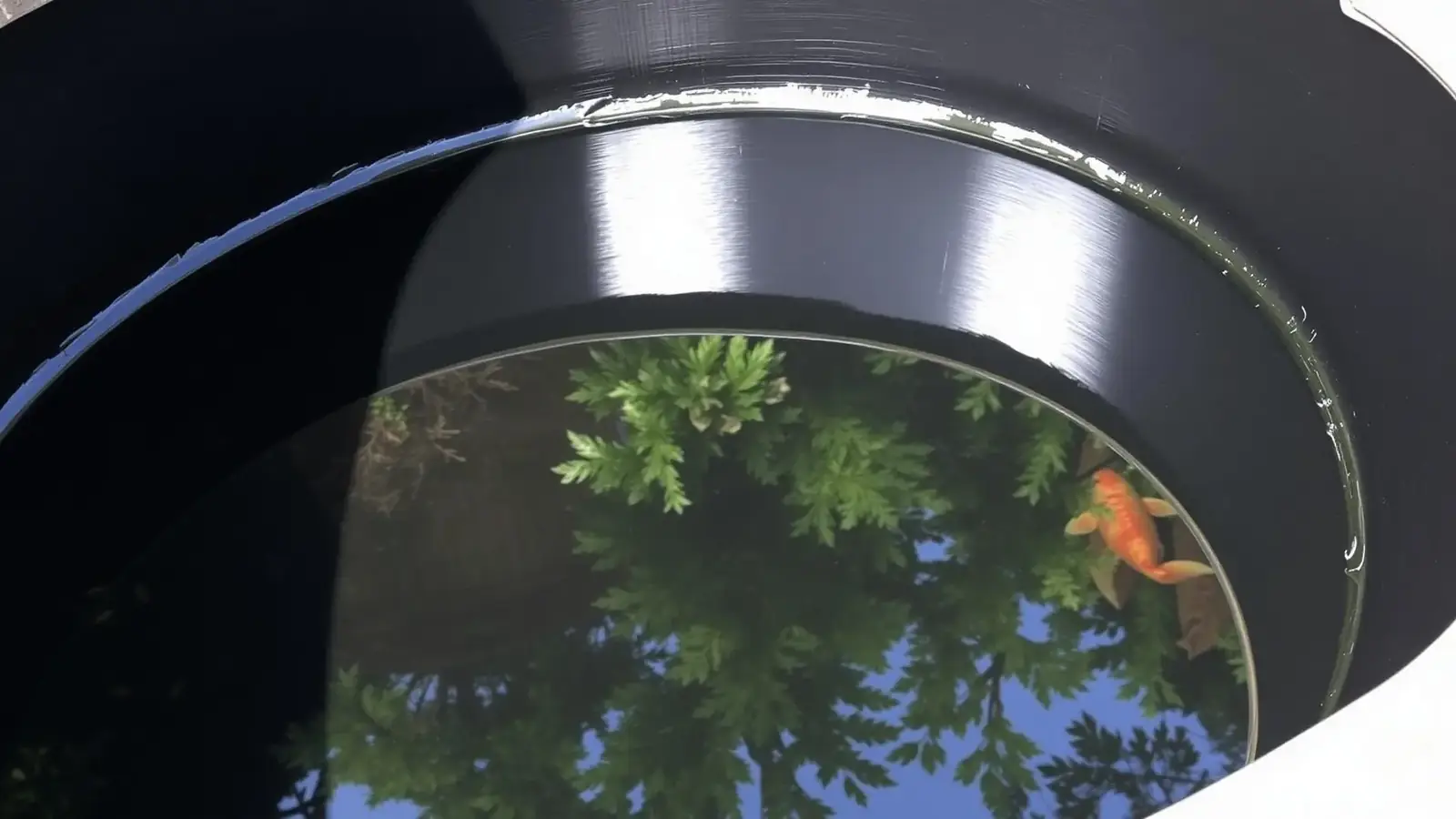
Both share the same core strength: a rigid, glossy, impact-resistant finish that can be specified in true black and reads as deep water from the bank.
Unlike the other entries in this hub — which compare flexible-membrane pond liners — fibreglass is a rigid system. If you are specifically weighing a preformed shell against a flexible liner, see our pond liner vs preformed pond guide.
Pros and cons
Where fibreglass is strong:
- Extremely durable — a properly laid GRP coating can last 25+ years with no maintenance.
- Rigid finish means no creases, folds or visible seams at the waterline.
- Brush-applied GRP is the standard way to rescue a cracked concrete koi pond.
- Preformed shells are quick to install on a simple shape.
Where it is weaker:
- Inflexible — preformed shells lock you into a fixed shape and size.
- Brush-applied GRP is a skilled trade with significant labour cost; not a DIY job.
- Resin cure is solvent-heavy; freshly laid GRP must be fully cured and rinsed before stocking fish.
- Repair after deep ground movement is harder than patching a flexible membrane.
Lifespan in the UK
A properly laid brush-applied GRP coating on a sound concrete or block substrate will reliably hold water for 25+ years and is often the longest-lived option of all on koi ponds where the structure underneath is itself permanent.
Preformed GRP shells have a similar headline life but are constrained by the original moulding — UV degradation and impact damage at the rim are the usual practical failure points.
Fish and wildlife safety
Fully cured GRP is inert and fish-safe; it is the standard finish on a huge proportion of high-end UK koi ponds. The important word is 'cured'. Fresh resin and styrene off-gas during cure and a brush-applied pond must be left to fully harden — typically a couple of weeks — then thoroughly rinsed and pH-tested before fish are introduced.
Installation
The two formats install very differently:
- Preformed shells are levelled into a sand-blinded excavation, backfilled in layers as the shell is filled with water, and finished with planted or stone margins at the rim.
- Brush-applied GRP is a skilled trade. The substrate is keyed, primed and then built up in alternating layers of resin and chopped-strand or woven glass mat, with each lap rolled out to remove air. The final topcoat is usually a flowcoat or gelcoat tinted black for visual depth.
Neither install is reversible in the way a flexible membrane is — once GRP is bonded to the substrate, it stays there.
Cost and sizing
Preformed GRP shells are priced per unit, with small (~1,000 L) garden shells in a broad band of £200–£500 and larger formal shapes well into four figures. Brush-applied GRP is priced per square metre of internal surface area at current UK trade rates and is labour-dominated — expect installed costs that are several times higher than a flexible membrane on a like-for-like basin.
Fibreglass rarely competes on raw cost. It earns its place when the pond is already concrete or block-built, when rigidity and visual finish are part of the brief, or when the owner specifically wants the longest available life on a koi pond.
Fibreglass vs reinforced polymer (RPM)
Fibreglass and reinforced polymer (RPM) overlap very little in practice — they answer different questions.
- Fibreglass wins on rigid waterproofing of existing concrete or blockwork structures, on koi-pond builds where a hard, glossy interior is part of the spec, and on small preformed shells where a flexible liner would be overkill.
- RPM wins on every freeform earth-bermed basin, on cost per square metre at any size above a small garden pond, on installation speed, and on the ability to adapt to settlement or future modification.
We do not publish a head-to-head matchup for fibreglass; the choice is usually between GRP for a hard-walled koi pond and reinforced polymer (RPM) for an earth-formed pond, lake or amenity basin.
Plan your install
Whichever material you settle on, the free pond liner size calculator converts basin dimensions into a sheet size in seconds. For a full side-by-side against our own membrane, see the reinforced polymer (RPM) spec sheet and the wider pond liner comparison.
Fibreglass pond liner FAQ
Related
Pond liner comparison
Full side-by-side of RPM, EPDM, PVC and butyl.
Open comparisonRPM 0.7 mm liner
Full spec, pricing and 45-year lifespan.
See productEPDM rubber pond liners
EPDM is a single-ply synthetic rubber pond liner that has been the default across the UK since the 1990s. As rubber pond liners go it is the most widely specified — plasticiser-free, fish-safe, and forgiving on awkward shelves — which is why EPDM rubber pond liners still earn their place across thousands of UK ponds every year.
ExploreButyl rubber pond liners
Butyl is the traditional premium UK rubber pond liner — a heavy, vulcanised rubber sheet that has been quietly holding water in estate lakes and koi ponds for decades. Of the classic rubber pond liners on the UK market, butyl rubber pond liners are the longest-serving specification; still a perfectly good material, and no longer the only sensible choice at the high end.
ExploreCompared Fibreglass and still want the longest-lasting option?
RPM 0.7 mm reinforced pond liner outlasts Fibreglass on lifespan, tear strength and UV resistance — and it's the material installers across the country trust. Get RPM quoted.