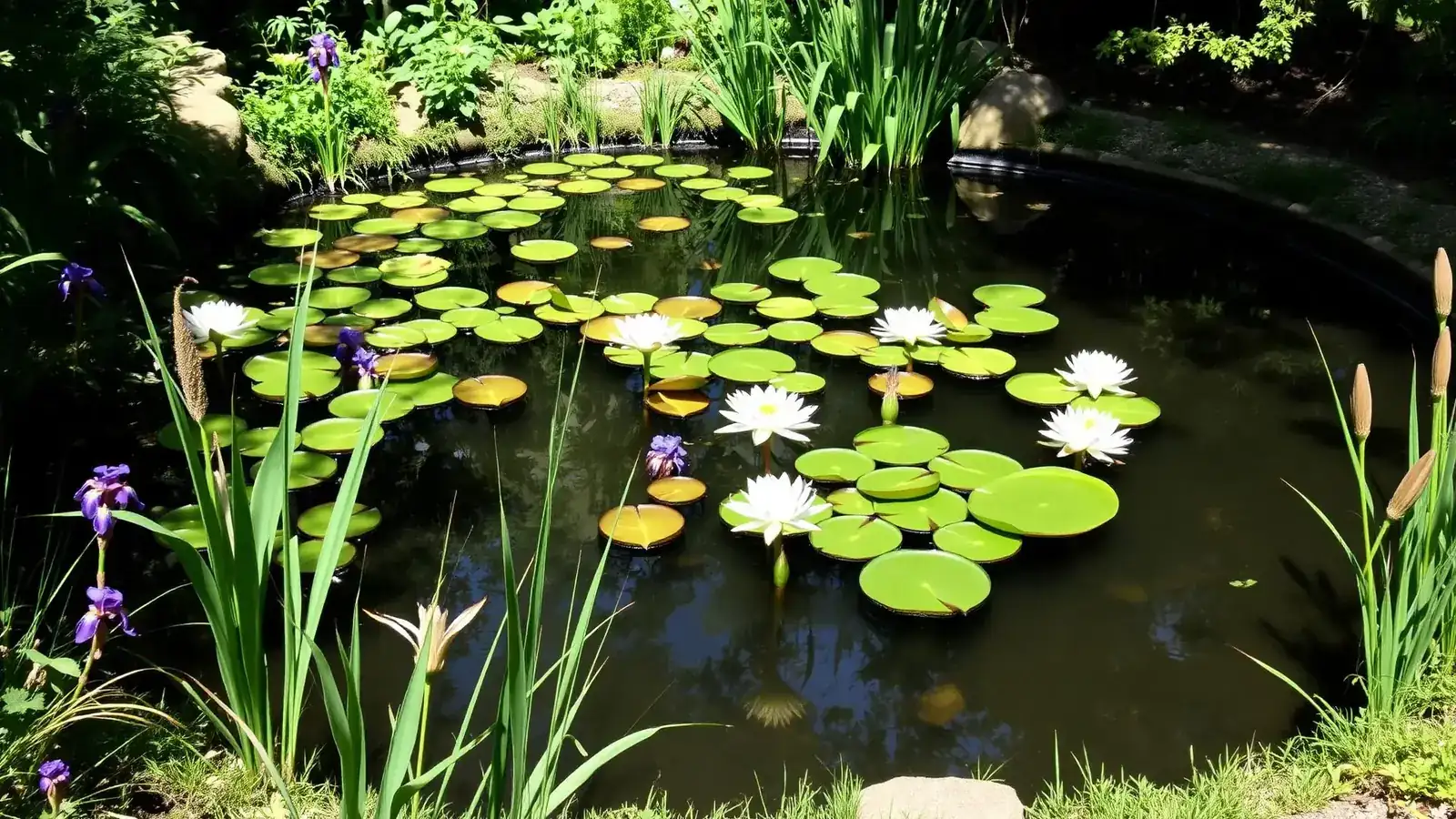
Butyl Rubber Pond Liners
Butyl is the traditional premium UK rubber pond liner — a heavy, vulcanised rubber sheet that has been quietly holding water in estate lakes and koi ponds for decades. Of the classic rubber pond liners on the UK market, butyl rubber pond liners are the longest-serving specification; still a perfectly good material, and no longer the only sensible choice at the high end.
Butyl rubber pond liners: full specification
Overview
Butyl rubber (isobutylene-isoprene) is a vulcanised synthetic rubber developed in the 1940s and adopted as the gold-standard pond liner in the UK from the 1960s onwards. It is typically supplied in 0.75 mm or 1.0 mm gauges as factory-cured sheets, with on-site joints made by solvent-glued lap seams.
It is a heavy, durable, high-quality material with a long British track record — and an increasingly niche supply chain as EPDM and reinforced polymer have displaced it from most new specifications.
This page compares butyl against other flexible-membrane pond liners. If you are weighing a rigid preformed shell instead, start with our pond liner vs preformed pond guide.
Pros and cons
Where butyl is strong:
- Outstanding longevity — documented UK installs comfortably past 40 years.
- Plasticiser-free, fish- and wildlife-safe from day one.
- Excellent puncture resistance for an unreinforced rubber at 0.75–1.0 mm.
- The natural choice when matching or repairing a heritage install.
Where it is weaker:
- Heavy at ~0.95 kg/m² with strong crease memory; transit folds can be stubborn.
- No heat weldability — every on-site seam is a solvent-glued lap joint that has to be prepped, weighted and inspected.
- Supply of large sheets is increasingly limited in the UK.
- Typically the most expensive option per square metre.
Lifespan in the UK
Butyl's headline strength is longevity. Field life of 30 years is routine and 40-plus year installs are documented across UK estate lakes and ornamental ponds. Manufacturer guarantees usually sit in the 20-year bracket, but real-world service comfortably exceeds that.
As with EPDM, the practical failure mode is rarely the rubber itself — it is a glued seam that has crept open or a puncture that was never properly underlaid.
Fish and wildlife safety
Butyl is one of the original koi-safe pond materials and remains fully fish- and wildlife-safe. It contains no plasticisers, does not affect pH, and is widely specified for high-value koi and natural swim ponds in the UK.
A short fill-and-settle period before stocking is sensible best practice but the membrane itself is inert in normal use.
Installation
Butyl is laid cold and drapes well into established excavations. The defining installation feature — and limitation — is the seam system:
- Single-sheet jobs are straightforward.
- Multi-sheet jobs are joined by solvent-glued lap seams, applied under a primer and weighted while they cure. A clean butyl seam is reliable for decades, but it asks more of the installer than a hot-air weld and remains the natural inspection point over the life of the pond.
A 300 gsm needle-punched geotextile underlay is the minimum, stepping up to 500 gsm on flint or shale. The perimeter is anchored in a 200–300 mm trench.
Cost and sizing
Size as length + 2× maximum depth + ~450 mm overlap, by width + 2× maximum depth + ~450 mm overlap.
Butyl typically sits 30–50% above EPDM or RPM at current UK trade rates, with bespoke fabrication and shrinking sheet availability pushing the gap further at larger sizes. For a small heritage repair the cost difference is rarely the deciding factor; for a new-build reservoir it usually is.
Butyl rubber vs reinforced polymer (RPM)
Butyl and reinforced polymer (RPM) overlap on lifespan and on fish safety. They differ sharply on weight and on how seams are made.
- Butyl wins when you are matching an existing butyl install, when heritage specification matters, or when an owner specifically wants the material with the longest documented UK track record.
- RPM wins on weight (roughly two-thirds lighter), on hot-air welded seams that test stronger than the parent sheet, and on freight and labour economics for anything above a single-sheet job.
For a fuller side-by-side see our RPM vs Butyl pond liner comparison.
Plan your install
Whichever material you settle on, the free pond liner size calculator converts basin dimensions into a sheet size in seconds. For a full side-by-side against our own membrane, see the reinforced polymer (RPM) spec sheet and the wider pond liner comparison.
Butyl rubber pond liner FAQ
Related
Pond liner comparison
Full side-by-side of RPM, EPDM, PVC and butyl.
Open comparisonRPM 0.7 mm liner
Full spec, pricing and 45-year lifespan.
See productEPDM rubber pond liners
EPDM is a single-ply synthetic rubber pond liner that has been the default across the UK since the 1990s. As rubber pond liners go it is the most widely specified — plasticiser-free, fish-safe, and forgiving on awkward shelves — which is why EPDM rubber pond liners still earn their place across thousands of UK ponds every year.
ExplorePVC pond liners
PVC — the most common plastic pond liner on UK garden-centre shelves — is the cheap, light option that earns its place on small ornamental features and short-term water gardens. It is also the only mainstream pond material that is not certified fish-safe in its standard form.
ExploreCompared Butyl rubber and still want the longest-lasting option?
RPM 0.7 mm reinforced pond liner outlasts Butyl rubber on lifespan, tear strength and UV resistance — and it's the material installers across the country trust. Get RPM quoted.