HDPE pond liners
HDPE is the heavyweight engineering choice for very large basins — landfill caps, mining ponds, industrial reservoirs. It is also occasionally specified for ponds, and the honest answer to the common question 'are HDPE pond liners any good?' is: excellent for the right job, overkill and awkward for the wrong one.
HDPE pond liners: full specification
Overview
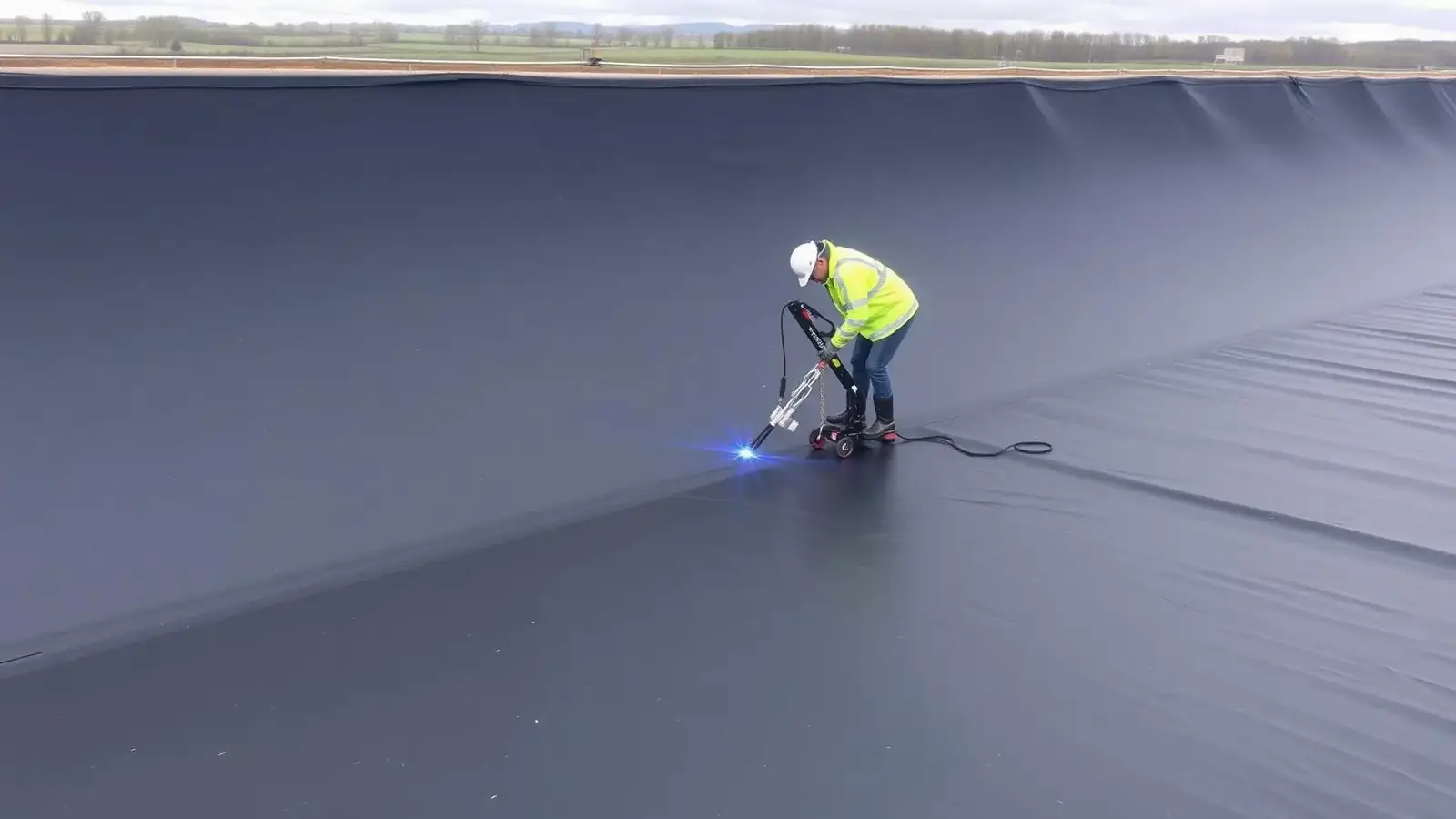
HDPE (high-density polyethylene) is a rigid, semi-crystalline thermoplastic geomembrane, typically supplied in 1.0 mm to 2.0 mm gauges and joined on site by wedge welding. It is the dominant material in UK landfill engineering, mining containment and large industrial reservoirs because it is chemically inert, UV-stable and extremely puncture-resistant.
It is also stiff, heavy and unforgiving on freeform shapes, which is why it is not the default for garden ponds, ornamental lakes or anything with tight shelves.
This page compares HDPE against other flexible-membrane pond liners. If you are weighing a rigid preformed shell instead, start with our pond liner vs preformed pond guide.
Pros and cons
Where HDPE is strong:
- Exceptional chemical resistance — handles slurry, leachate, fertigation and industrial effluent.
- 30–50 year design life from major geomembrane manufacturers.
- High puncture and tear resistance for an unreinforced sheet.
- Wedge-welded seams test stronger than the parent material.
Where it is weaker:
- Stiff and heavy — needs wedge-welding rigs and a competent CQA team on site.
- Poor drapeability on freeform shapes and tight shelves.
- Thermal expansion and contraction creates noticeable 'wrinkling' that has to be designed for.
- Overkill for most garden, ornamental and small fishery ponds.
Lifespan in the UK
Properly specified HDPE has a 30–50 year design life, with established performance data from decades of landfill and reservoir use. Subgrade preparation, panel layout and weld QA matter enormously — a well-installed HDPE basin is essentially a permanent piece of infrastructure; a poorly installed one fails at the seams.
UK Environment Agency and SEPA guidance for large containment projects typically requires destructive and non-destructive seam testing across the install, which is part of why HDPE costs what it does.
Fish and wildlife safety
HDPE is plasticiser-free, inert in water and used for potable-water reservoirs as well as fish-farming basins worldwide. It is fully fish- and wildlife-safe in standard pond use. For ornamental and koi applications the limiting factor is rarely toxicity — it is that the material is stiff, dark and difficult to detail invisibly at the bank edge.
Installation
HDPE is an industrial install, not a DIY one. Sheets are delivered as large rolls, hauled into position with plant, and joined on site by a wedge welder running a continuous double track with an air-test channel between the welds.
A 300–500 gsm needle-punched geotextile underlay is standard, often with a sand cushion on aggressive subsoils. Anchor trenching, slope-stability detailing and gas-venting design are all routine on large reservoirs. For anything but very large jobs, the plant and labour overhead makes HDPE economically uncompetitive with the lighter membranes.
Cost and sizing
HDPE is sold by the roll rather than the bespoke sheet. Material costs at current UK trade rates sit in a broad band of £4–£9 per m² depending on thickness and order volume, but the installed cost is dominated by the wedge-welding crew, CQA testing and plant — frequently doubling or tripling the material price on small jobs and falling sharply at reservoir scale.
For basins above roughly 2,000 m² HDPE becomes genuinely competitive on whole-of-life cost; below that, lighter weldable membranes almost always work out cheaper installed.
HDPE vs reinforced polymer (RPM)
HDPE and reinforced polymer (RPM) are both weldable engineered membranes, but they target different jobs.
- HDPE wins on chemical resistance for aggressive industrial containment, and on very large basins where wedge-welded roll-stock is the most efficient way to cover the area.
- RPM wins on weight (RPM at 0.7 mm is roughly a third of the weight of 1.5 mm HDPE), on freeform drapeability, on the absence of wrinkling, and on installed cost across the typical UK pond, golf-course, agricultural and lake-liner range up to several thousand square metres.
We do not currently publish a head-to-head matchup for HDPE; for most UK pond, lake and amenity work the practical comparison is between RPM, EPDM and butyl.
Plan your install
Whichever material you settle on, the free pond liner size calculator converts basin dimensions into a sheet size in seconds. For a full side-by-side against our own membrane, see the reinforced polymer (RPM) spec sheet and the wider pond liner comparison.
HDPE pond liner FAQ
Related
Pond liner comparison
Full side-by-side of RPM, EPDM, PVC and butyl.
Open comparisonRPM 0.7 mm liner
Full spec, pricing and 45-year lifespan.
See productEPDM rubber pond liners
EPDM is a single-ply synthetic rubber pond liner that has been the default across the UK since the 1990s. As rubber pond liners go it is the most widely specified — plasticiser-free, fish-safe, and forgiving on awkward shelves — which is why EPDM rubber pond liners still earn their place across thousands of UK ponds every year.
ExploreButyl rubber pond liners
Butyl is the traditional premium UK rubber pond liner — a heavy, vulcanised rubber sheet that has been quietly holding water in estate lakes and koi ponds for decades. Of the classic rubber pond liners on the UK market, butyl rubber pond liners are the longest-serving specification; still a perfectly good material, and no longer the only sensible choice at the high end.
ExploreCompared HDPE and still want the longest-lasting option?
RPM 0.7 mm reinforced pond liner outlasts HDPE on lifespan, tear strength and UV resistance — and it's the material installers across the country trust. Get RPM quoted.