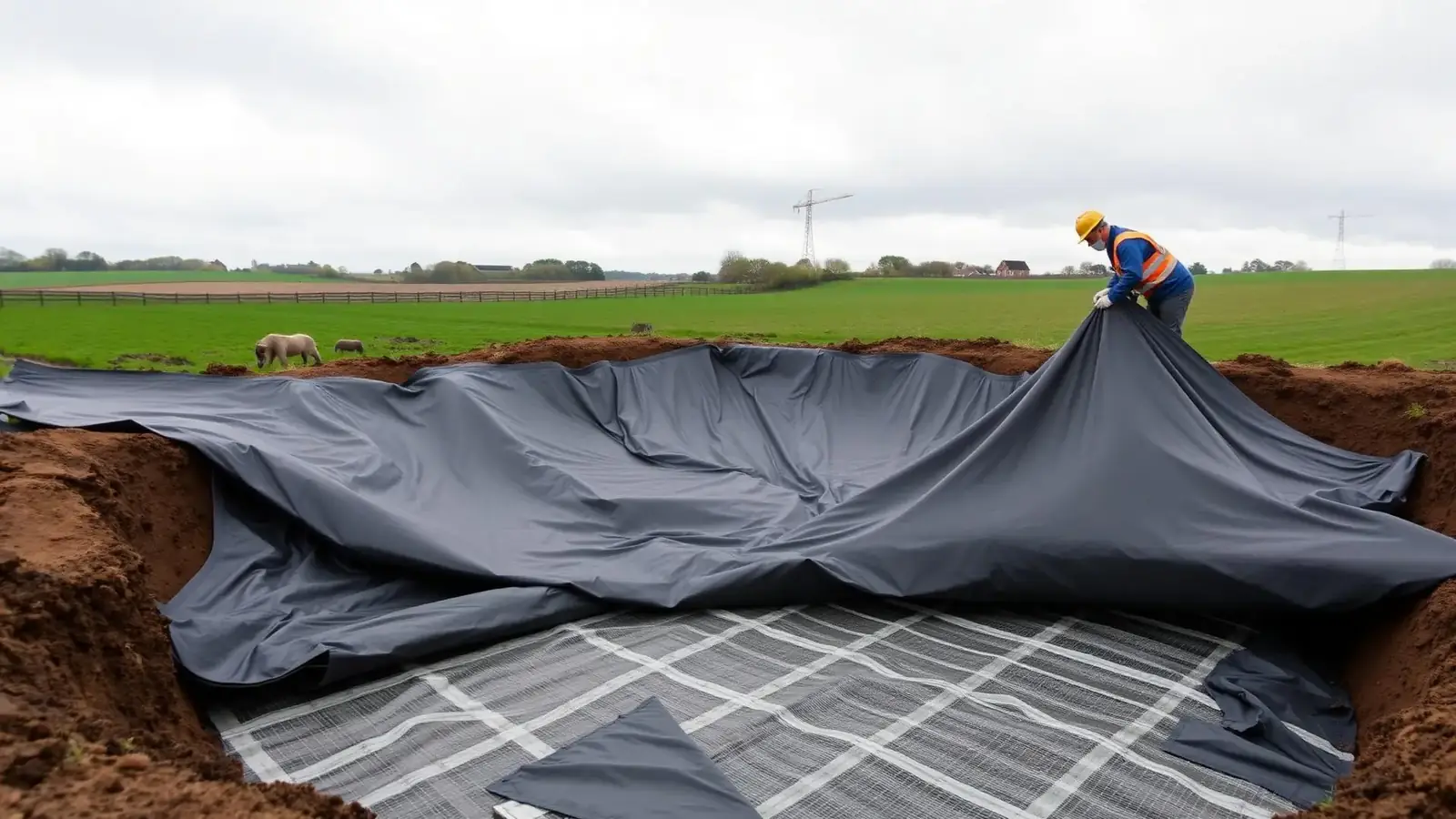
RPE pond liners
RPE (reinforced polyethylene) is a scrim-reinforced polyethylene membrane that has become popular as a lightweight alternative to EPDM on UK garden and small commercial ponds. It is essentially a close cousin of reinforced polymer (RPM) — same idea, different recipe.
RPE pond liners: full specification
Overview
RPE pond liners are a thin polyethylene sheet sandwiched around a woven polyester or polyethylene scrim. The reinforcement carries the tensile load, allowing the membrane to be much thinner and lighter than an equivalent unreinforced rubber.
Typical UK pond-grade RPE is supplied around 0.5 mm thick at roughly 0.4 kg/m², usually as folded sheets up to a few hundred square metres, with on-site joints made by hot-air or wedge welding.
This page compares RPE against other flexible-membrane pond liners. If you are weighing a rigid preformed shell instead, start with our pond liner vs preformed pond guide.
Pros and cons
Where RPE is strong:
- Very light and easy to handle, even on large sheets.
- Reinforced scrim spreads point loads better than unreinforced PVC of the same gauge.
- Weldable on site with hot air.
- Cheaper per square metre than RPM in many ranges.
Where it is weaker:
- UV stability varies significantly between grades — check the published warranty carefully.
- Thinner overall than RPM (~0.5 mm vs 0.7 mm) so puncture margin is lower.
- Polyethylene skin is less elastic than the polyolefin alloys used in higher-grade reinforced membranes.
- Quality and fish-safe certification varies; the cheaper end of the market is genuinely budget product.
Lifespan in the UK
Manufacturer-quoted lifespans for UK pond-grade RPE typically sit in the 20–30 year band, with field experience harder to pin down because the material is newer than EPDM or butyl on UK ponds.
In practice, lifespan is dominated by UV grade and underlay quality. A premium-grade RPE laid over a 300 gsm geotextile in a properly dressed basin will comfortably exceed 20 years; a budget RPE thrown straight onto stony ground will not.
Fish and wildlife safety
Most UK-marketed RPE pond liners are plasticiser-free and certified fish- and wildlife-safe — confirm this on the specific product datasheet rather than assuming it from the material family. Polyethylene itself is chemically inert in water and the reinforcement scrim is encapsulated, so there is no exposed thread in contact with the pond.
Installation
Installation is broadly the same as for any modern reinforced membrane:
- Dress the excavation and remove sharp stones.
- Lay a 300 gsm needle-punched geotextile underlay, stepping up to 500 gsm on flint or shale.
- Roll out and overlap the panels.
- Hot-air weld the seams.
- Anchor the perimeter in a 200–300 mm trench.
RPE's lightness is its main practical advantage — large sheets that would need three or four hands in EPDM can often be positioned by two installers in RPE.
Cost and sizing
Size as length + 2× maximum depth + ~450 mm overlap, by width + 2× maximum depth + ~450 mm overlap.
RPE pricing in the UK is wide. Budget pond-grade RPE can come in around 30–40% below RPM per square metre at current trade rates; premium fish-safe grades with strong UV warranties close most of that gap. Total installed cost depends heavily on which grade you specify — it is worth reading the datasheet line by line.
RPE vs reinforced polymer (RPM)
RPE and reinforced polymer (RPM) share an architecture: a woven scrim carrying the load between two polymer skins. The differences are in the skin chemistry and the resulting performance envelope.
- RPE wins on headline upfront price in the budget grades, and on lightness at very thin gauges.
- RPM wins on UV stability, on cold flexibility, on puncture margin at a slightly thicker 0.7 mm, and on the consistency of the fish-safe certification across the product range.
We do not currently publish a head-to-head matchup for RPE; the typical UK choice for an upgrade over EPDM is between mid-range RPE and reinforced polymer (RPM), and that choice usually comes down to warranty terms and underlay specification rather than the membrane on its own.
Plan your install
Whichever material you settle on, the free pond liner size calculator converts basin dimensions into a sheet size in seconds. For a full side-by-side against our own membrane, see the reinforced polymer (RPM) spec sheet and the wider pond liner comparison.
RPE pond liner FAQ
Related
Pond liner comparison
Full side-by-side of RPM, EPDM, PVC and butyl.
Open comparisonRPM 0.7 mm liner
Full spec, pricing and 45-year lifespan.
See productEPDM rubber pond liners
EPDM is a single-ply synthetic rubber pond liner that has been the default across the UK since the 1990s. As rubber pond liners go it is the most widely specified — plasticiser-free, fish-safe, and forgiving on awkward shelves — which is why EPDM rubber pond liners still earn their place across thousands of UK ponds every year.
ExploreButyl rubber pond liners
Butyl is the traditional premium UK rubber pond liner — a heavy, vulcanised rubber sheet that has been quietly holding water in estate lakes and koi ponds for decades. Of the classic rubber pond liners on the UK market, butyl rubber pond liners are the longest-serving specification; still a perfectly good material, and no longer the only sensible choice at the high end.
ExploreCompared RPE and still want the longest-lasting option?
RPM 0.7 mm reinforced pond liner outlasts RPE on lifespan, tear strength and UV resistance — and it's the material installers across the country trust. Get RPM quoted.