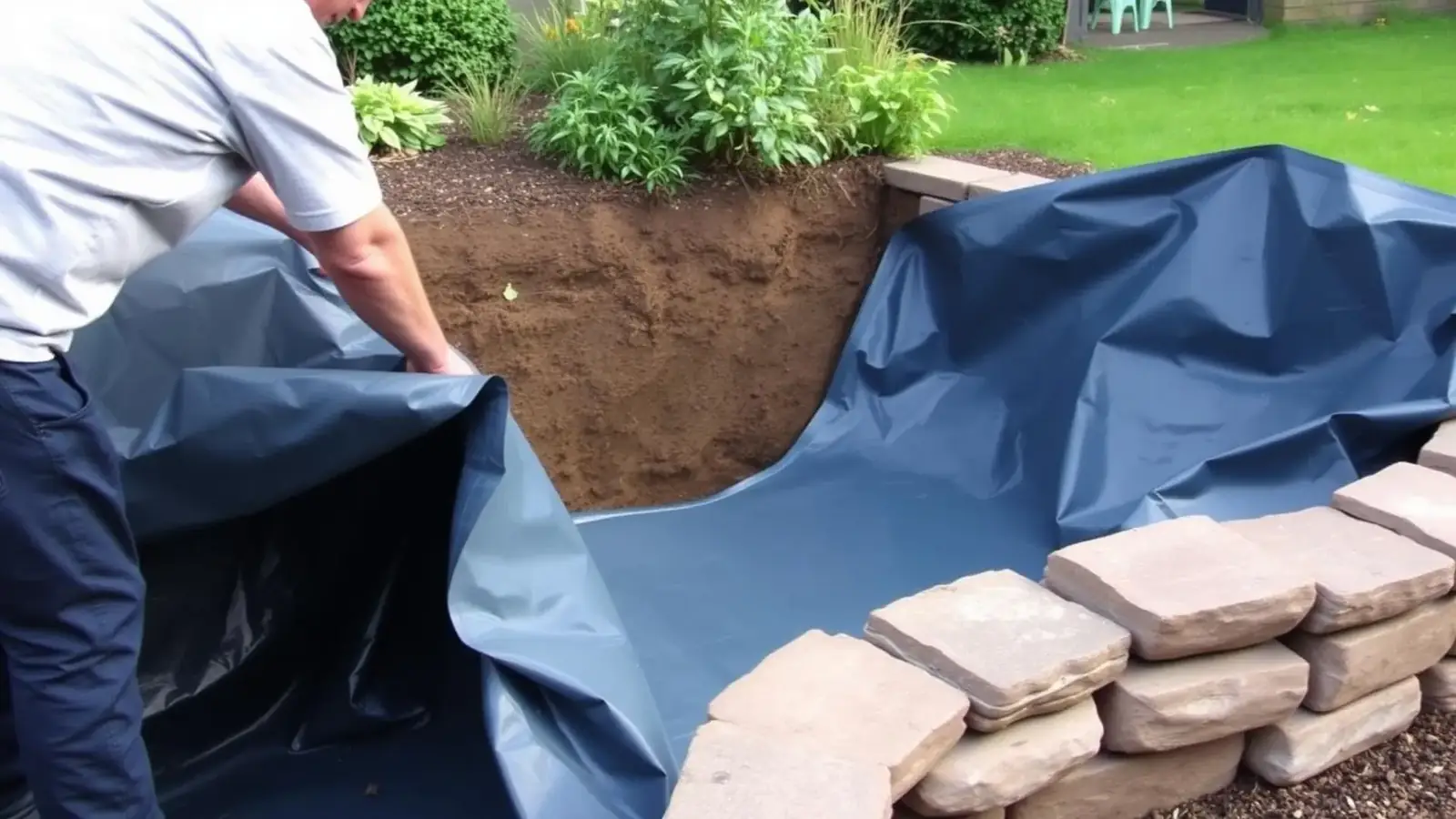
PVC pond liners
PVC — the most common plastic pond liner on UK garden-centre shelves — is the cheap, light option that earns its place on small ornamental features and short-term water gardens. It is also the only mainstream pond material that is not certified fish-safe in its standard form.
PVC pond liners: full specification
Overview
PVC (polyvinyl chloride) pond liners are a thermoplastic sheet usually supplied in 0.5 mm or 0.75 mm gauges. The plastic is made flexible by phthalate plasticisers — the same chemistry that gives PVC its characteristic smell and feel.
The material is light, cheap and easy to handle, which is why it dominates the garden-centre end of the UK pond market. It is also a fundamentally different material from the synthetic rubbers (EPDM, butyl) and reinforced polyolefins (RPM, RPE) typically specified higher up the range.
This page compares PVC against other flexible-membrane pond liners. If you are weighing a rigid preformed shell instead, start with our pond liner vs preformed pond guide.
Pros and cons
Where PVC is strong:
- Cheapest mainstream pond liner per square metre in the UK.
- Very light and easy for a single person to handle on small jobs.
- Folds tightly into small features without crease memory.
- Weldable with solvent or hot air, which is unusual at this price.
Where it is weaker:
- Standard PVC contains phthalate plasticisers and is not certified fish-safe.
- Short lifespan — typically 10–15 years before brittleness and folds-cracking.
- Poor cold flexibility, around -5 °C — UK winters do shorten its life.
- Welded seams are weaker than the parent sheet, so large jobs are seam-sensitive.
Lifespan in the UK
Realistic UK field life for PVC pond liners is 10–15 years, with budget grades failing closer to 8 years above the waterline where UV exposure is highest. The classic failure pattern is plasticiser migration: the sheet hardens, loses elasticity, and splits at folds.
Manufacturer guarantees of 10 years are common; longer claims usually rely on the liner spending its entire life submerged and shaded, which is rarely the reality on a real pond.
Fish and wildlife safety
This is the critical distinction. Standard PVC pond liners contain phthalate plasticisers that can leach into water over the life of the membrane and are not certified fish-safe by mainstream UK suppliers. Fine for an ornamental water feature with no livestock; not appropriate for koi, goldfish or stocked wildlife ponds.
A small number of specialist food-grade PVC products do exist but are not the same as the general-purpose PVC pond liners sold at retail. If fish safety matters, choose EPDM, butyl or reinforced polymer instead.
Installation
PVC is the easiest mainstream pond liner for a DIY install. It is light, drapes into small features without help, and tolerates tight folds.
A 300 gsm geotextile underlay is still the standard recommendation — PVC is unreinforced and punctures readily on flints or roots. On larger jobs, PVC can be hot-air or solvent welded, but the seams are notably weaker than the parent sheet, so panel layout and welder skill matter. Anchor the edge in a 150–200 mm trench.
Cost and sizing
Size as length + 2× maximum depth + ~300 mm overlap, by width + 2× maximum depth + ~300 mm overlap.
PVC is the cheapest mainstream pond liner in the UK — typically 40–55% less per square metre than RPM or EPDM at current trade rates. That gap narrows sharply once you account for shorter lifespan: replacing a PVC liner every 12 years against a 25–45 year alternative usually evens the total cost of ownership out, before counting the labour of relining a mature, planted pond.
PVC vs reinforced polymer (RPM)
PVC and reinforced polymer (RPM) sit at opposite ends of the price-and-lifespan curve.
- PVC wins on upfront cost and on tiny ornamental features that will be redone within a decade anyway.
- RPM wins decisively on lifespan, on fish safety (RPM is plasticiser-free), on UV stability, and on welded-seam integrity for any pond above ~10 m².
For a fuller side-by-side see our RPM vs PVC pond liner comparison.
Plan your install
Whichever material you settle on, the free pond liner size calculator converts basin dimensions into a sheet size in seconds. For a full side-by-side against our own membrane, see the reinforced polymer (RPM) spec sheet and the wider pond liner comparison.
PVC pond liner FAQ
Related
Pond liner comparison
Full side-by-side of RPM, EPDM, PVC and butyl.
Open comparisonRPM 0.7 mm liner
Full spec, pricing and 45-year lifespan.
See productEPDM rubber pond liners
EPDM is a single-ply synthetic rubber pond liner that has been the default across the UK since the 1990s. As rubber pond liners go it is the most widely specified — plasticiser-free, fish-safe, and forgiving on awkward shelves — which is why EPDM rubber pond liners still earn their place across thousands of UK ponds every year.
ExploreButyl rubber pond liners
Butyl is the traditional premium UK rubber pond liner — a heavy, vulcanised rubber sheet that has been quietly holding water in estate lakes and koi ponds for decades. Of the classic rubber pond liners on the UK market, butyl rubber pond liners are the longest-serving specification; still a perfectly good material, and no longer the only sensible choice at the high end.
ExploreCompared PVC and still want the longest-lasting option?
RPM 0.7 mm reinforced pond liner outlasts PVC on lifespan, tear strength and UV resistance — and it's the material installers across the country trust. Get RPM quoted.